Airport Weather & Environmental Monitoring System
| Company | OpsSky |
|---|
Images

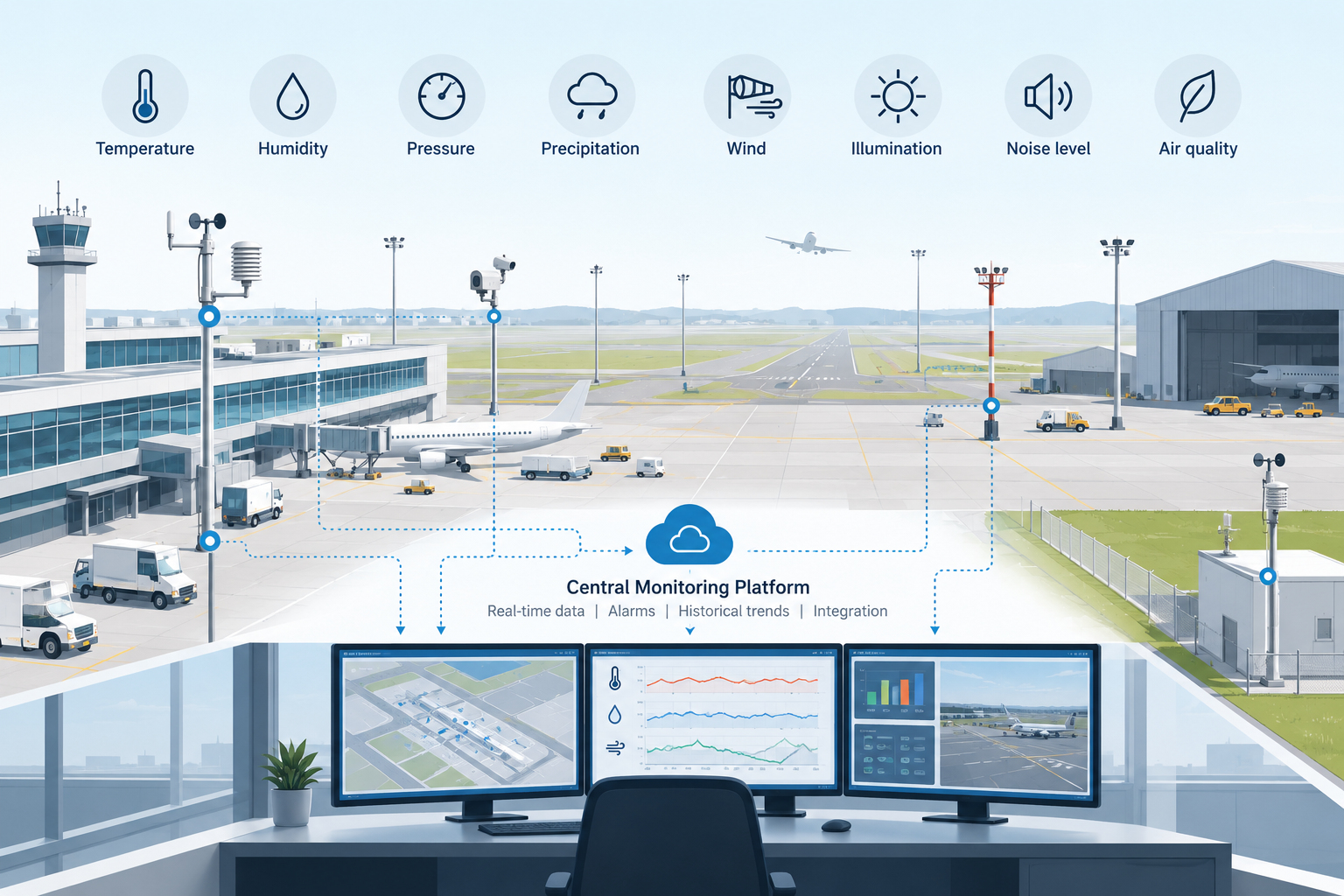
An Airport Weather & Environmental Monitoring System provides continuous monitoring of weather and environmental conditions across airport and airfield infrastructure. It combines distributed sensors, data acquisition devices, communications, and centralized monitoring software to give airport operators real-time awareness of conditions that may affect operational safety, infrastructure, personnel, and equipment.
The system complements aviation-specific meteorological systems by extending monitoring to operational and infrastructure areas such as aprons, hangars, technical buildings, equipment rooms, warehouses, maintenance areas, landside facilities, and other critical airport locations.
Typical monitored parameters can include temperature, relative humidity, atmospheric pressure, precipitation, wind conditions, illumination, noise levels, and other environmental parameters depending on the selected sensors.
Key Functions
- Continuous monitoring of weather and environmental parameters across multiple airport locations.
- Distributed indoor and outdoor sensor deployment.
- Real-time visualization through a centralized monitoring dashboard.
- Configurable warning and alarm thresholds.
- Historical data recording and trend analysis.
- Detection of abnormal or potentially hazardous environmental conditions.
- Remote monitoring of geographically distributed airport facilities.
- Integration with existing BMS (Building Management System), SCADA (Supervisory Control and Data Acquisition), maintenance, and other airport operational systems.
- Scalable architecture allowing additional sensors and monitoring points to be added as airport requirements grow.
Airport Applications
The system can support environmental monitoring around terminal and technical buildings, hangars and maintenance facilities, airport warehouses, equipment rooms, communication and surveillance infrastructure, apron areas, remote installations, and other critical facilities.
This provides airport operators with a common environmental monitoring layer that supports preventive maintenance, infrastructure protection, workplace safety, operational planning, and faster response to abnormal conditions.
Other Products From OpsSky

Airport Infrastructure & Structural Health Monitoring System


Airport Roof Snow Load & Structural Monitoring System

Airport Surface Condition & Ice Detection System

Airport Traffic Monitoring System — ADS-B Based
