Stargate project at Brussels Airport significantly accelerates sustainable airport operations
| Company | Brussels Airport |
|---|---|
| Date | 23.09.2026 |
More than 30 innovation projects lead to electrification, digital cargo handling and a test with a unique blending installation for sustainable aviation fuel
Today, Brussels Airport presented the results of Stargate, a European innovation project that tested more than 30 projects for sustainable airport operations over the past five years. Together with 22 partners, innovative solutions were developed around decarbonisation, local quality of life and sustainable mobility. This led, among other things, to an acceleration in the electrification of ground handling equipment and the roll-out of a digital delivery system for cargo operations. As a final pilot project, Brussels Airport is the first European airport to test a mobile blending installation for sustainable aviation fuel (SAF).
Over the past five years, Brussels Airport has been the testing ground for researching and trialling innovative solutions for sustainable aviation within the Stargate programme. Together with a consortium of 22 partners and with the support of the European Commission, the aim was to develop innovations and initiatives for more sustainable aviation. Several projects have since led to permanent implementations at the airport, offering valuable insights for making the aviation sector more sustainable.
“Over the past five years, Stargate has turned ambition into concrete action. We have been able to test innovative technologies in daily airport operations, learn what works and what still requires further development. We actively share that knowledge with other airports so that the whole sector can become more sustainable more quickly. Lots of what we have tested today within the framework of Stargate will become the standard practice at European airports tomorrow. Stargate has been a success, which could only be achieved thanks to the good collaboration between all partners. We will continue to work towards a more sustainable airport with the same conviction and ambition.”, says Arnaud Feist, CEO of Brussels Airport.
Lower CO2 emissions, an improved local living environment and more sustainable transport
In terms of decarbonisation, Stargate has accelerated efforts to test and roll out electric ground handling equipment. What was still new technology in 2021 and was first extensively tested together with DHL, is today part of daily operations. Thanks to Stargate, Skytanking was also able to have two unique customised electric fuel dispensers developed, which are now deployed daily. Electrification has also been advanced in Athens, including for dedicated apron service vehicles.
Hydrogen-powered ground handling equipment was also tested, both at Brussels Airport and at Aéroport de Toulouse-Blagnac. This showed that hydrogen has potential where electrification is not feasible, but that challenges remain in terms of infrastructure and supply.
The initiatives focusing on decarbonisation also have a positive impact on the local living environment. Another pilot project was the test with the Taxibot, together with TUI. With this semi-automatic towing system, a plane can taxi without using its engines. Measurements by VITO showed that this can result in a reduction of 10 to 15 decibels of noise and up to 80% in ultrafine particles. Although the operational benefits depend on taxi times at an airport, the project provided valuable insights that are now being shared with other airports.
For cargo operations, among other things, a fully digital process for the delivery and collection of goods was rolled out, supported by BRUcloud applications: the Digital Green Lane. Today, 95% of all goods in the cargo zone at Brussels Airport are processed via this system, resulting in shorter waiting times for lorries, less paper and lower CO2 emissions.

The third important pillar within Stargate is the modal shift, increasing the share of sustainable journeys to and from the airport. At both Brussels Airport and Aéroport de Toulouse-Blagnac, a sustainable mobility plan has been developed to map the needs of passengers and staff and thus be able to take the necessary actions. Shared bicycles, an information kiosk on public transport and a feasibility study for high-speed rail are some concrete initiatives here. At Budapest Airport, an app was also developed to improve the safety and navigation of vehicles on the tarmac.
Together with the bike manager, many quick wins for cycle traffic were rolled out, from signage to additional cycle paths. Cycle traffic to the airport has been increasing for 2 years in a row. On the cycle path towards the terminal, the bicycle counter registered an increase of 20% in 2025. In 2026, we’ve already counted an average of 7% more cyclists at all counting points.
Unique final pilot project: first mobile blending installation for SAF in Europe
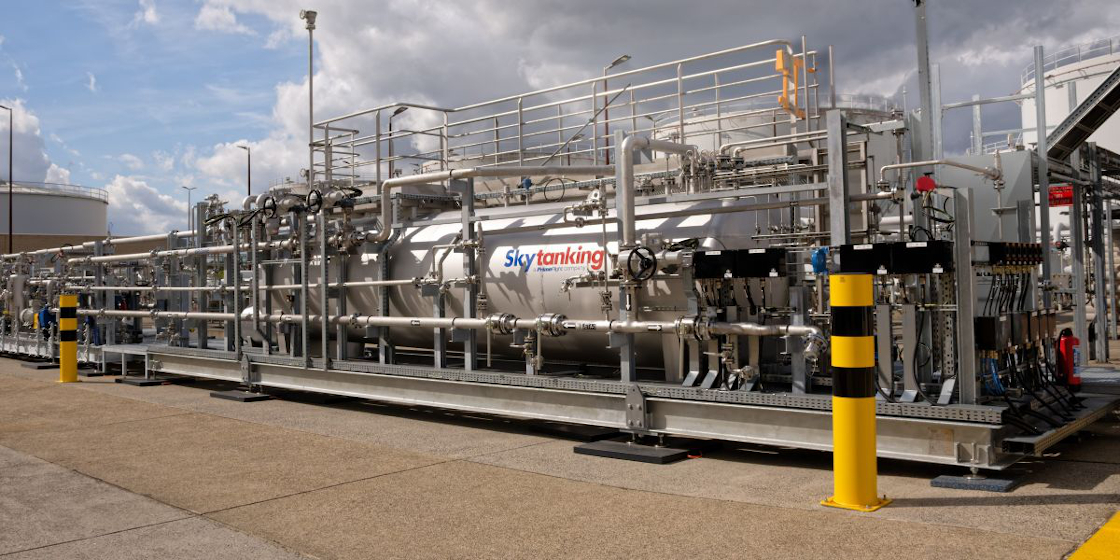
The final Stargate project is a pilot test with a mobile blending installation for the on-site production of sustainable aviation fuel, SAF (Sustainable Aviation Fuel), together with Skytanking. Brussels Airport is one of the first airports in the world to test such an installation, and the very first in Europe.
SAF is a blend of a sustainable low-carbon fuel component and kerosene. With this blending installation, kerosene can be blended on demand with a higher share of this sustainable component. Today, airlines in Europe are required to use 2% SAF; at Brussels Airport, this is supplied via an underground pipeline system.
The aim is to investigate how targeted fuel delivery to airlines wishing to fly with a higher SAF content can work in practice and what the impact is on local air quality. This final pilot project will continue until the end of this year.
The partners in the Stargate consortium are Athens International Airport, Budapest Airport, Aéroport de Toulouse-Blagnac, Brussels Airlines, TUI, DHL Aviation, Engie Laborelec, Air Cargo Belgium, Skytanking, skeyes, To70 Aviation, Lux Mobility, Hasselt University, expertise centre Erasmus UPT, IES R&D, Sopra Steria, Province of Flemish Brabant, Quatra, the Flemish Institute for Technological Research (VITO), NMBS, the Flemish Institute for Logistics and Arup.
This project has received subsidies from the European Union’s Horizon 2020 research and innovation programme under subsidy agreement GA101037053.
Contact
Leopoldlaan
1930 Zaventem
Belgium
- +32 2 753 77 53
