
From Power Units to Stand Performance: What Airports Will Specify in 2026
| Company | C.D.R Technology OÜ |
|---|---|
| Date | 16.02.2026 |
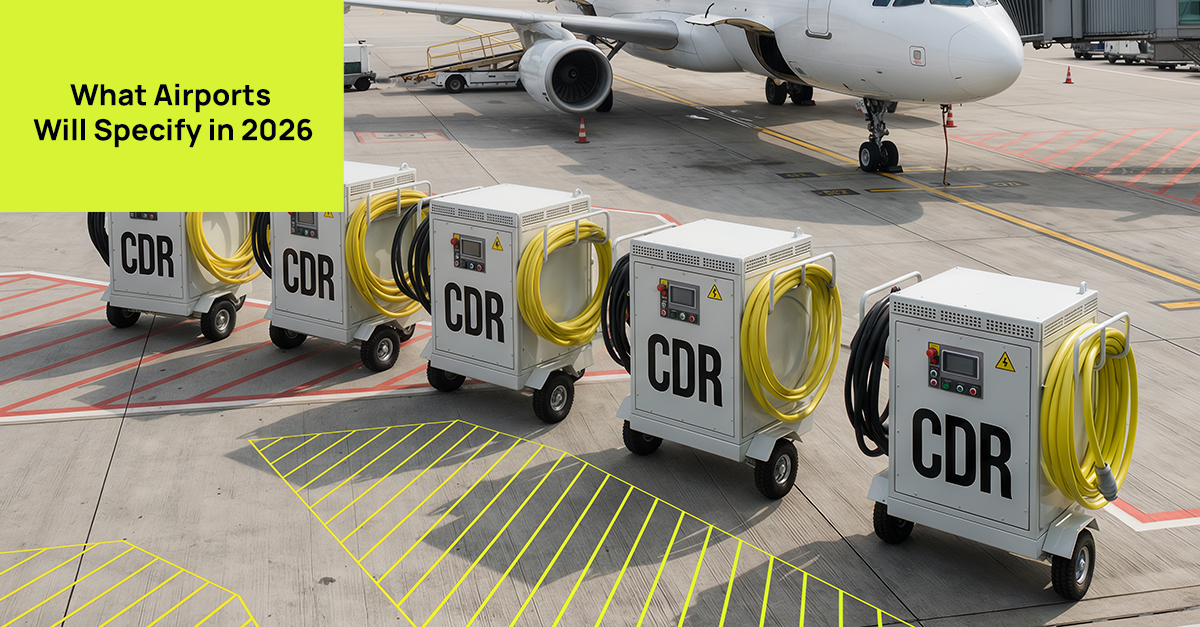
From Power Units to Stand Performance: What Airports Will Specify in 2026
As airports accelerate electrification and modernisation, expectations for ground power are changing fundamentally. What was once assessed as standalone equipment is now evaluated as part of a broader operational ecosystem at the gate.
By 2026, discussions around 400 Hz and DC ground power will move further away from nominal ratings and procurement checklists. Instead, airports, MROs and operators will increasingly prioritise stand-level performance, predictability and measurable outcomes across the full lifecycle.
Power quality becomes a baseline requirement
One of the most consistent shifts in recent tenders and technical specifications is the growing emphasis on power quality at the aircraft interface. Stable frequency, a clean sinusoidal waveform, low harmonic distortion and predictable voltage performance under varying loads are no longer treated as added value. They are baseline expectations.
Modern aircraft electrical architectures are more sensitive to fluctuations than previous generations. At the same time, cable runs are getting longer, stands are denser and simultaneous connections are becoming more common. Even small deviations at the unit can propagate into operational issues once aircraft systems are connected.
As a result, specifications increasingly require demonstrable compliance with ISO 6858 under realistic operating conditions, not only nominal laboratory results. Airports are beginning to ask not just whether a unit meets the standard, but how stability is maintained across distance, temperature and load variation.
From unit testing to operational verification
This shift is also changing attitudes toward testing and acceptance.
Routine production tests remain essential, but they are no longer sufficient on their own. Factory Acceptance Testing (FAT) is increasingly expected to simulate real operating scenarios, including extended load operation, thermal equilibrium, protection logic response and voltage compensation performance.
Operational experience across Europe and the Middle East has shown that many post-commissioning issues originate not from component defects, but from gaps between assumed and actual conditions. Longer-than-planned cable routes, higher ambient temperatures or different load profiles can expose weaknesses that were never validated at the factory stage.
By 2026, structured FAT documentation, traceable measurements and transparent test records are becoming part of procurement expectations rather than optional extras. Airports want evidence that equipment behaviour has been verified before it reaches the apron.
Digital visibility moves into the foreground
Another defining trend is the growing demand for digital transparency.
Ground power is no longer isolated from airport-wide systems. Energy monitoring platforms, asset management tools and SCADA environments increasingly expect ground power equipment to provide data, logs and diagnostic information.
This is driven by several factors. Electrified GSE fleets increase overall energy demand. Sustainability reporting requires more precise consumption data. Maintenance teams want earlier anomaly detection to reduce unplanned downtime.
As a result, specifications now frequently include requirements for event logging, interface readiness and remote diagnostics capability. By 2026, the absence of structured digital visibility will be viewed as a limitation rather than a cost-saving choice.
Lifecycle thinking replaces short-term optimisation
Procurement criteria are also shifting toward lifecycle resilience.
Rather than focusing solely on acquisition cost, airports are paying closer attention to thermal performance, component stability, maintenance intervals and long-term availability of spare parts. This is particularly visible in regions with extreme operating conditions.
In hot-climate hubs, thermal efficiency directly affects reliability and energy losses during peak periods. In coastal or dusty environments, enclosure design and material selection influence service life more than nominal ratings. In regions modernising legacy infrastructure, flexibility and phased integration are critical.
These factors are driving a more disciplined approach to component selection, system architecture and service readiness. Predictable operation over years is becoming a stronger differentiator than short-term performance figures.
Regional nuances shape technical priorities
While the overall direction is consistent, regional priorities remain distinct.
European airports continue to lead in energy transparency, digital integration and environmental reporting. Middle Eastern hubs emphasise reliability under extreme temperatures and sustained peak loads. Central Asia often focuses on step-by-step modernisation while accommodating mixed fleets. North Africa frequently prioritises durability and serviceability in challenging environmental conditions.
What unites these regions is a shared move away from isolated equipment decisions toward integrated, performance-driven ground power strategies.
What this means for 2026 specifications
By 2026, airports will increasingly specify ground power not as a standalone product, but as a contributor to overall stand performance. Technical requirements will place greater weight on measurable stability, documented testing, digital readiness and lifecycle behaviour.
This evolution reflects a broader maturity in how ground power is understood within airport operations. Reliable energy delivery, data visibility and long-term predictability are no longer secondary considerations. They define whether electrification efforts deliver their intended operational and environmental benefits.
Ground power is becoming less about what a unit can deliver on paper and more about how a stand performs in daily operation. That shift is reshaping specifications, procurement strategies and expectations across the industry.
Contact
Taevavärava tee 6b, Lehmja küla
Rae vald, Harju maakond, 75306
Estonia
- +372 558 56 94
