
Testing in Aircraft Ground Power Systems
| Company | CDR Technology OÜ |
|---|---|
| Date | 13.01.2026 |
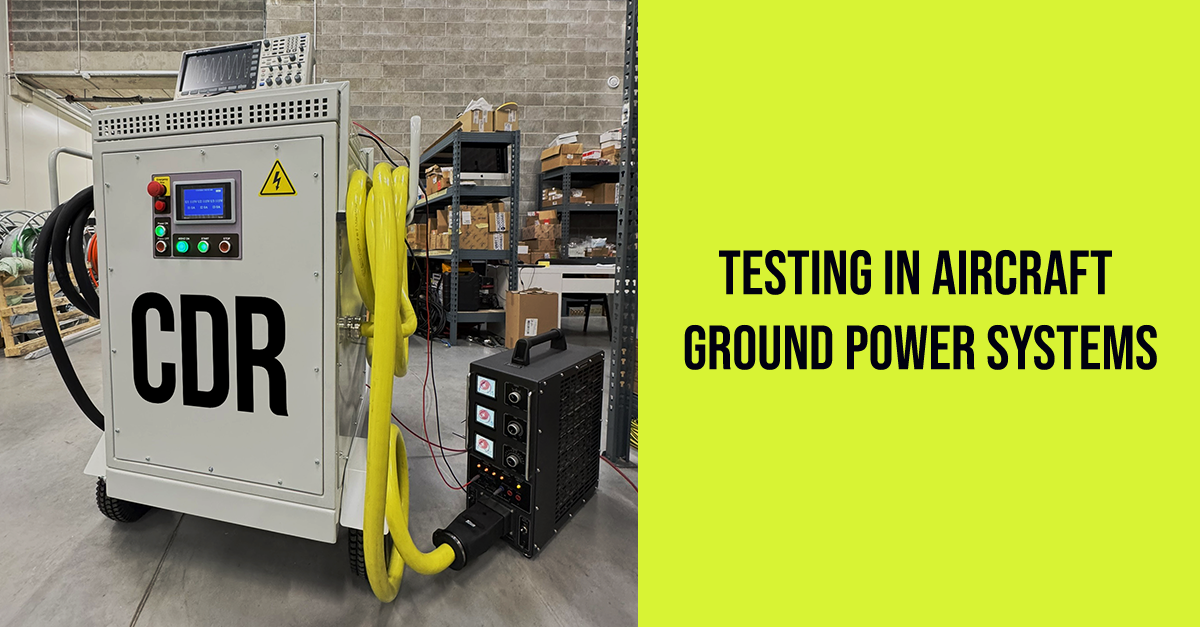
As airports modernise ground power infrastructure, testing has become a defining factor for operational reliability. Today, acceptance and verification go far beyond basic functional checks.
In practice, testing of 400 Hz and 28 V DC systems is usually divided into several key stages.
Type testing validates a design concept. It confirms that a system architecture complies with standards such as ISO 6858, relevant EN and IEC requirements, and can safely deliver the required electrical parameters under defined conditions.
Routine testing is performed on every unit during production. It focuses on wiring integrity, insulation resistance, grounding continuity and basic functional operation.
Factory Acceptance Testing (FAT) is where performance is evaluated under realistic operating scenarios. Units are operated at rated load, thermal behaviour is observed over time, voltage stability and protection logic are verified, and safety functions are tested as part of the complete system.
Finally, Site Acceptance Testing (SAT) confirms that the equipment performs correctly once installed, accounting for environmental conditions and integration with airport infrastructure.
Lessons from the Field.
Operational experience shows that many issues discovered on site are not caused by component failures, but by gaps between testing assumptions and real conditions.
In several European airports, voltage instability occurred after commissioning when cable runs turned out to be longer than initially planned. FAT procedures that did not include compensation testing under extended distances failed to reveal the issue early.
In hot-climate hubs in the Middle East, insufficient thermal testing led to derating under peak summer temperatures, increasing energy losses and reducing equipment availability during high-traffic periods.
At coastal airports, inadequate verification of enclosure sealing and grounding resulted in accelerated corrosion and intermittent faults within the first years of operation.
These cases underline a common conclusion: testing that reflects real operating environments significantly reduces long-term operational risk.
Why Testing Strategy Matters.
As aircraft electrical systems become more sensitive and ground operations more data-driven, airports increasingly expect testing to validate stability, safety and lifecycle performance, not just compliance at nominal values.
A structured testing strategy, aligned with international standards and informed by real operational conditions, has become a baseline requirement for modern ground power infrastructure.
Contact
Taevavärava tee 6b, Lehmja küla
Rae vald, Harju maakond, 75306
Estonia
- +372 558 56 94
