
The Announcement No Passenger Can Miss: The Speech Technology Closing the Gap
| Company | Simpleway |
|---|---|
| Date | 18.08.2026 |
Language, noise, and hearing can all get between a passenger and the announcement meant for them. Here is how text-to-speech and speech-to-text help airports close the gap.
An airport announcement is only useful if it reaches the person it was meant for, and that is harder than it sounds. The traveler who does not speak the local language, the passenger who cannot hear well over the noise of the concourse, the family watching the flight information screens in an unfamiliar terminal: each of them can miss the one message that concerned them. This article looks at how airports are using speech technology to reach the passengers
When Sound Alone Is Not Enough
Most airport communication still runs on the spoken word, and for plenty of passengers that is enough. The trouble starts the moment someone cannot make out the audio. Terminals are loud places, and an announcement competes with crowd noise, overlapping pages from other gates, and the general hum of people on the move. Many travelers also have some degree of hearing difficulty. A message that is only spoken is a message some passengers will always miss.
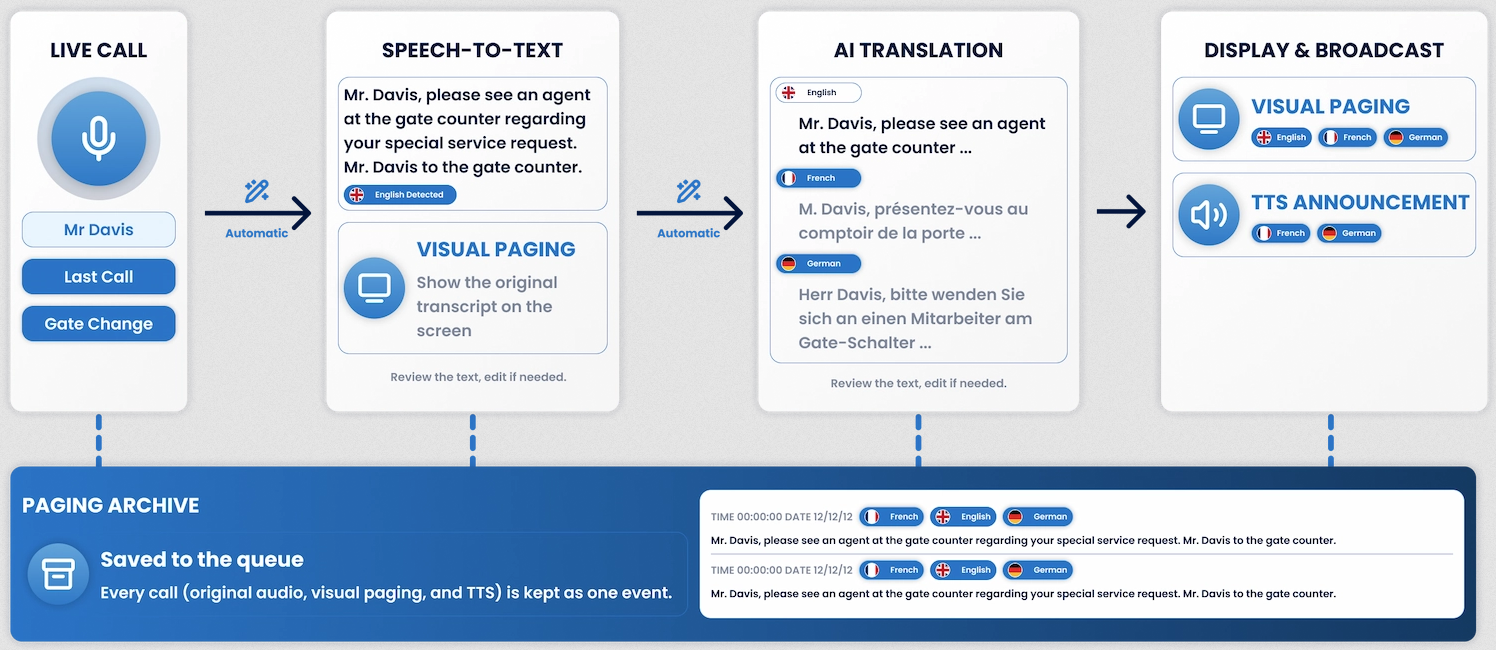
The fix is to show the announcement as well as play it. An automated announcement already exists as text, so it can go straight onto the flight information displays. A live call spoken into a microphone is harder, and that is where speech-to-text helps: it turns a spoken page into text, so even a live announcement can appear on screen. Either way, a passenger who cannot hear the call can read it instead. Showing every message in text also helps airports keep up with the accessibility and language-access rules they answer to, such as the ADA, Title VI, the Accessible Canada Act, and ATPDR. And when a safety message needs to stand out, the displays can switch to a high-contrast alert that is hard to overlook.
The Language a Passenger Actually Speaks
The harder gap to close is language. A passenger who does not read or speak the local language can be standing right in front of a screen and have no way of knowing whether any of it is meant for them.
For routine announcements, text-to-speech does the heavy lifting. Boarding calls, gate changes, and delays are generated straight from live flight data and spoken aloud in clear, natural voices, in every language an airport chooses to cover. When a gate changes or a flight is delayed, the announcement rewrites and replays itself, with airline names, destinations, and flight numbers pronounced correctly and no one recording a new version. A single airport can run announcements in dozens of languages this way, around the clock, without adding to anyone’s workload.
“The text-to-speech implementation has been a game changer for us. Before, we were chasing down different paging processes as well as video processes and trying to get them to align. With our text to speech via Airport CX, we see multilingual and ADA capabilities. It is just out of the box. It is fantastic.”
- Matthew Chandler, Cloud and Systems Engineer, Tucson Airport Authority
Live announcements are the more interesting case. The same speech-to-text that puts a live page on screen can hand the transcript to AI translation. The staff member picks the languages the call should go out in, and it is translated in seconds, then shown on the displays, read aloud by text-to-speech in each language, or both. A gate agent can make a call in English and have it ready on the screens and in the speakers in French and German moments later. The message still comes from a person. It just reaches everyone at the gate, not only those who speak the same language.
Was the Call Actually Made?
Every so often a passenger misses a flight and insists they were never called. Without a record, it comes down to one account against another, and the airport is usually the one left to deal with it.
This is where a system like Simpleway’s Airport CX earns its keep. It logs every announcement and stamps each one with the time it played. Live pages made at a microphone are transcribed by speech-to-text, so they sit alongside every automated and pre-recorded announcement in the same log, and all of it is searchable by name, flight, gate, or zone. If a passenger says they were never paged, staff can look up the name, find the exact announcement, and see both the wording and the moment it went out. What once meant scrubbing through hours of audio, if any was kept at all, now takes seconds. The same record helps with compliance reviews and with piecing together how an irregular operation actually unfolded.
Learn more about how every announcement gets played, displayed as text, and stored as a searchable record.
Everyone Gets the Message
Air travel is stressful enough without missing the one announcement meant for you. When a message reaches a passenger in a language they understand, whether they are listening or reading, much of that tension eases. The traveler who does not speak the local language is not left guessing. The passenger who cannot hear the call sees the same words on screen. A family in an unfamiliar terminal knows where to be and when.
For staff, the effect is just as real. Less time goes to making the same call over and over, and more of it goes to being present on the floor, where a calm word in person often does more than any announcement. The system takes care of the routine so people can take care of the people.
Airports are remembered for moments like these, and a traveler who felt informed and looked after carries that impression with them. Reaching every passenger this way is what Airport CX is built for. It brings text-to-speech, speech-to-text, live translation, and a searchable record of every announcement into a single system. The result is the announcement no passenger can miss.
To see what Airport CX can do for your terminal, learn more about Airport CX or request a demo to see it in your own environment.
Contact
Simpleway Europe a.s.
Na Okraji 335/42
162 00 Prague
Czech Republic
-
Simpleway North America
Simpleway Inc.
1621 Central Avenue Cheyenne
Wyoming
82001
USA
- +420 245 009 855
- +1 (307) 248 4033
