Airfield Crash Alarm System (ACAS)
| Company | Copperchase Limited |
|---|---|
| Product code | ACAS |
Images
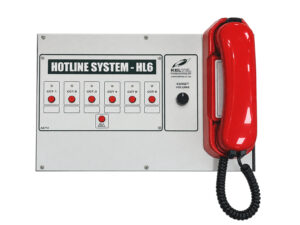
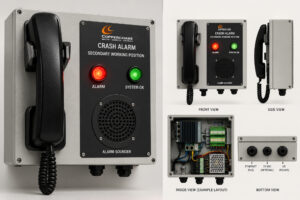
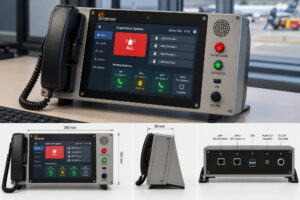
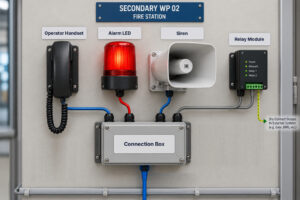
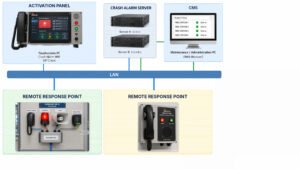
ACAS (Airfield Crash Alarm System) is Copperchase’s airport crash alarm system and emergency communications platform for airports and airfields. It gives the air traffic controller a single, fast and unambiguous way to alert the rescue and fire-fighting service (RFFS/ARFF), the airport fire station and other emergency responders, and to speak to them, the moment an aircraft emergency is declared.
ACAS combines crash alarm activation, emergency voice communications and auxiliary control in one product. After many years of supplying and supporting crash alarm systems, Copperchase now designs, engineers and supports ACAS in-house, building on its proven technology.
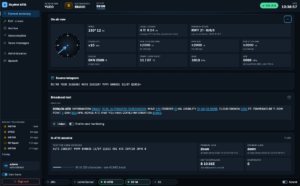
At the ATCO desk, the Activation Panel offers a full touch-screen interface with large controls sized so the right response is pressed first time. A single “All Call” alerts every configured response point at once, while each individual point stays one tap away for point-to-point alerting. As each position acknowledges by lifting its handset, it joins a live voice conference with the tower. The panel shows in real time which points have been alerted, which have acknowledged and which are in the conference.
At each response point (fire, police, hospital or kitchen), ACAS can be fitted with a compact touch-screen or a SIP or analogue red telephone (crash phone), with lamp and sounder, voice communication, or both. Configurable relay outputs automate the response: opening fire-bay doors, shutting down kitchen equipment, triggering sounders and strobes, or driving a general-purpose output. All outputs reset automatically when the controller ends the alarm.
Built on an IT-based VoIP architecture, ACAS runs over Ethernet or fibre optic, and connects legacy analogue equipment through FXO/FXS gateways, so airports can migrate at their own pace. Every communication line is monitored around the clock: a failed or degraded link raises an operator alert immediately, not at the next test, and a failed position never stops the alarm reaching the others. Redundant communications are an easy-to-configure option at the core, the Activation Panel and every remote point. Every alarm, acknowledgement, call, fault and recovery is time-stamped in the system log.
ACAS is designed in line with ICAO Annex 14 Volume I (Chapter 9), ICAO Doc 9137 Part 1, EASA ADR.OPS.B.010 and applicable national aerodrome regulations. The result is lower lifecycle cost, with one spares pool and one training programme, faster deployment and stronger safety assurance, on a platform built to grow with the airfield.
Whether replacing a legacy button-and-lamp crash alarm or equipping a new ATC tower, Copperchase’s Airfield Crash Alarm System (ACAS) gives air traffic controllers a fast, reliable, fully monitored crash alarm.
Find out more at https://www.copperchase.co.uk/product-services
System
Architecture: IT-based VoIP (SIP) platform with analogue FXO/FXS interfaces
Core equipment: 19″ rack solution, example 8U wall cabinet (482 mm W × 355 mm H × 450 mm D) housing ACAS server PC, router and VoIP gateway
Platform: One common hardware and software platform for core, Activation Panel and remote points; role set by configuration
Interface: Full touch-screen HMI with handset
Alarm modes: All Call (all configured points simultaneously); Point-to-Point (individual remote point)
Voice: Automatic voice conference; each point joins on acknowledgement and can leave and rejoin while the alarm is active
Incoming calls: Remote points can call the tower; caller identified on the HMI
Status display: Green: normal/available; Grey: offline; Yellow: alarm active, not acknowledged; Red: acknowledged/emergency communication active; separate fault indication
Monitoring display: Network status, acknowledgement status and conference participants for every remote point; configurable point names
Remote connection points
Terminal options: Compact touch-screen; SIP or analogue red telephone handset; weatherproof call station; gooseneck intercom; dispatcher terminal
Alarm indication: Lamp/strobe and sounder, audio communication, or both
Acknowledgement: Lift handset; alarm indication stops and acknowledgement is shown at the tower
Auxiliary relay outputs: Kitchen shutdown, fire-bay doors, sounders and strobes, general-purpose relay; auto-reset at alarm end
Communications and resilience
Transmission media: Ethernet CAT5, fibre optic
Analogue interfacing: VoIP gateways with 4× FXO / 4× FXS ports (e.g. Sangoma Vega 60G, Grandstream UCM6304, Yeastar NeoGate TA400/TA410)
Redundancy: Optional redundant communications at the core, the Activation Panel and every remote point
Line supervision: 24/7 monitoring of all communication lines with immediate operator alert on failure or degraded service; automatic recovery
Graceful degradation: Failure of one remote point does not affect alarm operation to the others
Logging: Time-stamped log of alarm activation and termination, acknowledgements, voice call set-up and clear-down, faults and recoveries
Standards
Regulatory basis: ICAO Annex 14 Vol. I Ch. 9; ICAO Doc 9137 Part 1 (Rescue and Fire Fighting); EASA ADR.OPS.B.010 and associated AMC/GM; national aerodrome regulations
Supplier: Copperchase Ltd: ISO 9001 certified, Cyber Essentials, SafeContractor approved
Other Products From Copperchase Limited
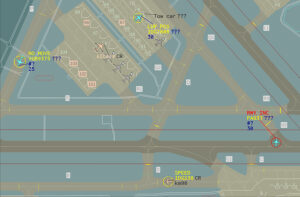
A-SMGCS (Advanced Surface Movement Guidance and Control System)

ADS-B Surveillance System
ATC Message Handling System (AFTN / AMHS)
AGL (Aeronautical Ground Lighting) Control & Monitoring System