Voice & Datalink ATIS and VOLMET
| Company | Copperchase Limited |
|---|
Images
Voice & Datalink ATIS and VOLMET from Copperchase is an integrated meteorological broadcast suite for airports and air navigation service providers. It delivers ATIS and VOLMET on voice and data link from one platform, one web console and one login, and runs unattended 24/7.
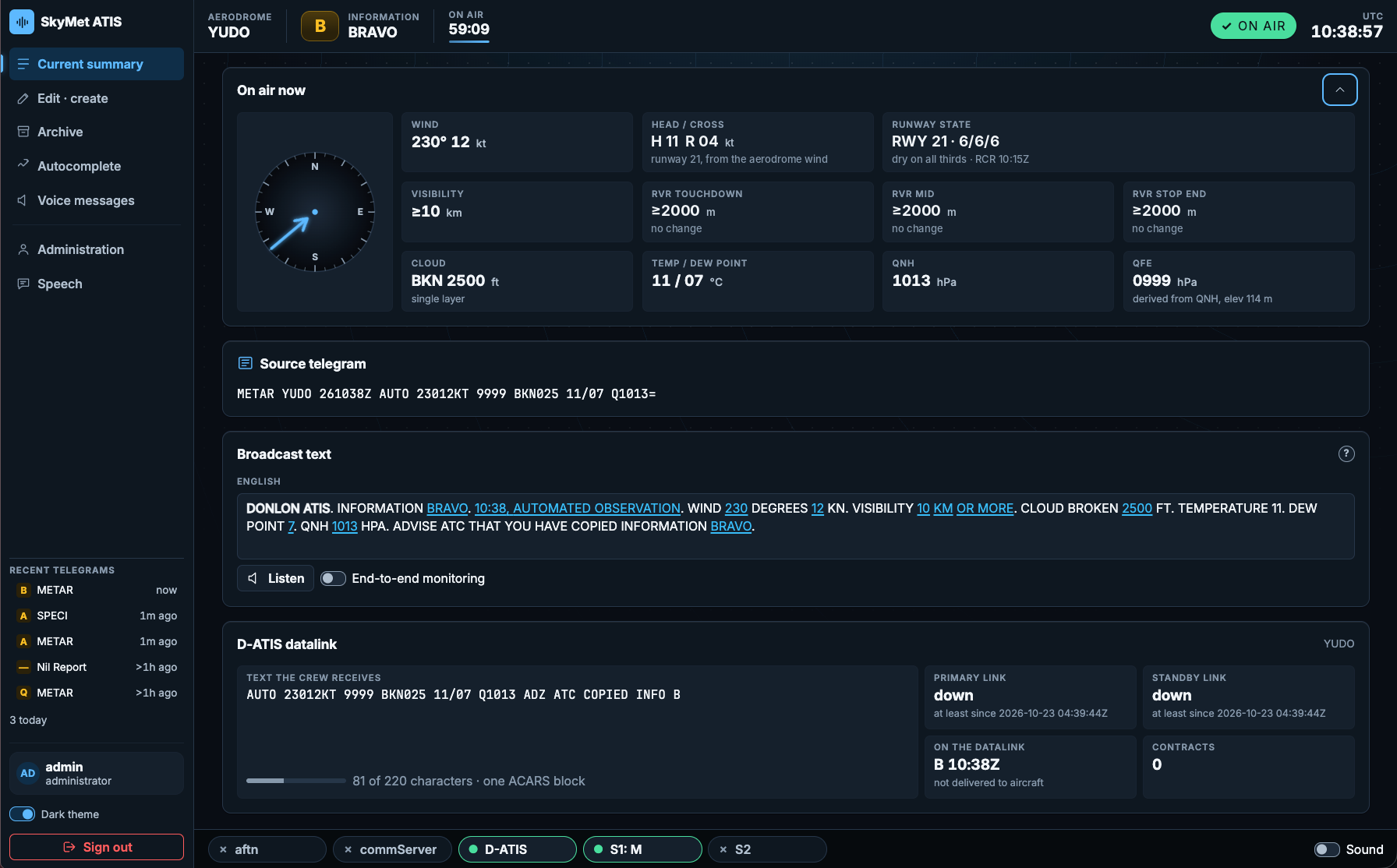
ATIS turns every valid METAR, SPECI, MET REPORT or SPECIAL into a complete new report in ICAO Annex 11 §4.3 order with the next information designator (A–Z); duplicates and NIL messages never consume a letter. Operators add only what has no automatic source: runway in use, approach types and operational information, kept across automatic updates. GRF runway condition (RWYCC per runway third) arrives by SNOWTAM or from the runway condition reporting system. The same report and designator are published to D-ATIS (ACARS, DEMAND and CONTRACT) at the same moment and reconciled continuously, and are available to telephone callers over SIP, meteorological boards and a public page.
VOLMET keeps the latest valid METAR or SPECI and the TAF in force for up to 30 aerodromes, and every SIGMET in force for up to 5 FIRs, and cycles through them continuously, SIGMET first. Corrections, amendments and cancellations take effect on their own, including volcanic ash and tropical cyclone SIGMET; expired or erroneous reports become NIL REPORT, NIL FORECAST or NIL SIGMET without waiting for an operator. The same reports reach aircraft on request over D-VOLMET, through the shared data link.
Both services use local neural text-to-speech on the server, with no Internet connection required, in English and one optional second language, each with its own text and voice. Wording follows ICAO phraseology (Doc 9432, and Doc 9377 for VOLMET with VHF or HF wording), with NOT AVAILABLE for missing elements. Audio goes on air through analogue line output and EUROCAE ED-137 VoIP side by side, with off-air monitoring and a silence alarm.
Release can be automatic, semi-automatic with pre-listen, or manual for ATIS; SPECI and NIL on expiry go on air at once. Both are safe by design: a report that cannot be fully voiced is rejected rather than cut short, ATIS data that expires becomes a Nil Report, and VOLMET never produces a false NIL SIGMET. Main and reserve nodes with automatic master/slave arbitration take over in 30 seconds or less, keeping the current report, designator and programme.
The browser-based console needs no installation. It shows what is on air phrase by phrase with live listening, the D-ATIS text against the 800-character limit, the VOLMET programme with each item’s time to expiry, and the state of every connection. A full archive supports replay and export, and shared user administration covers both systems.
ATIS and VOLMET can be delivered together on the same hosts or separately. Key performance: MET message to broadcast-ready in 10 s or less; ATIS on air to D-ATIS publication in 5 s or less; hot-standby takeover in 30 s or less.
Meteorological input
Messages (ATIS): METAR, SPECI (AUTO, NIL, COR); MET REPORT, SPECIAL
Messages (VOLMET): METAR, SPECI (AUTO, NIL, COR); TAF (AMD, COR, NIL, CNL); SIGMET WS, WV, WC, CNL
Runway state (ATIS): GRF: SNOWTAM (PANS-AIM) or site runway condition system; console entry
Formats: Text (TAC), including WMO bulletins; IWXXM 2021-2 and 3.0
Channels: Input directory, AFTN (ITA-2 / IA-5), AMHS via the site gateway, Communication Server (serial, TCP, UDP, file); VOLMET console entry (option)
Validation: Syntax, location, time and value ranges; reason shown to the operator; duplicates suppressed
Acceptance (VOLMET): TAF up to 180 min, SIGMET up to 720 min before validity
ATIS report and release
ATIS type: Combined, arrival or departure; several instances per host
Release: Automatic, semi-automatic or manual; replace at once or at end of cycle
Designators: A–Z in sequence, restart at 00:00 UTC; kept on switchover
Validity: 0–1440 min from observation (default 60); Nil Report on expiry
Long report: Warning above a set duration (default 30 s)
VOLMET programme and release
Capacity: Up to 30 aerodromes and 5 FIRs per programme
Programme: Site-configured order, by aerodrome or by type; SIGMET first; one instance per broadcast
Release: Automatic or semi-automatic (default hold 5 min); replace at once or at next pass
Validity: METAR/SPECI 0–1440 min (default 60); TAF and SIGMET to end of validity
Band: VHF, HF or both, with the Doc 9377 wording for each
Speech
Engine: Local neural text-to-speech; engine and voice versions fixed in each delivery
Languages: English plus one optional language, each with its own text and voice
Speech rate: 0.5–1.5 per voice, per-element overrides
Site tuning: Pronunciation rules, phrases and aerodrome names edited from the console
Broadcast and audio
Languages on air: Two channels at once, or in sequence on one
Analogue: Sound card line out (ATIS 2 channels; VOLMET per channel); line-in off-air monitoring
VoIP: EUROCAE ED-137B/C Part 1, G.711 A/µ-law; ATIS up to 2 legs, VOLMET one leg per channel
ED-137 roles: Radio, Stand-alone, GRS
Telephone (ATIS): SIP; 4 or more simultaneous calls; 0–10 repeats per call (default 3)
Data link (D-ATIS and D-VOLMET)
Transport: ACARS, ARINC 620/622 over MATIP/BATAP, 2 sessions, shared by D-ATIS and D-VOLMET
DSP: SITA; ARINC (Collins Aerospace) on request
D-ATIS services: DEMAND and CONTRACT; arrival, departure and en-route requests
D-ATIS message: ED-89A character set; up to 800 characters, 220 target
D-ATIS integrity: Reconciled with the voice report every 90 s; alarm on mismatch
D-VOLMET service: METAR/SPECI, TAF and SIGMET on aircraft request (ICAO Annex 11 §4.4); same reports as the voice programme
Operator interfaces
Console: Web (Chromium or Firefox), no installation; 1920×1080; light and dark themes
Shared console: One console and login for ATIS and VOLMET, switch between systems
Positions: 4 or more per instance, in step within 2 s
MET boards (ATIS): 10 or more per instance; site-defined profiles (tower, approach)
Public and watch view: Read-only ATIS public page; read-only watch views with live listening
Redundancy and record
Architecture: Main and reserve nodes, automatic master/slave arbitration, no extra hardware
Takeover: 30 s or less; ATIS report and designator kept; VOLMET programme kept with no NIL items from the switch; consoles reconnect
Archive: All messages, reports, audio and operator actions; event journal
Retention: Configurable, default 30 days; package and CSV export (ATIS)
Platform and security
OS: RHEL 9 family (Oracle Linux 9), x86-64, physical or VM
Hardware: Standard server and sound card; AFTN adaptor, radio and SIP gateways as the site needs
Delivery: ATIS and VOLMET together on the same hosts, or either alone
Access: User and Administrator roles, shared by both systems and enforced on the server
Protection: TLS (HTTPS/WSS), PBKDF2-SHA256, host firewall on
Monitoring: Per-connection alarms with acknowledge; levelled logs; automatic restart
Performance
MET message to broadcast-ready: 10 s or less (ATIS and VOLMET)
ATIS on air to D-ATIS publication: 5 s or less
Hot-standby takeover: 30 s or less
Operation: 24/7, unattended
Standards
ICAO: Annex 3 (Ch. 4, 6, 7, 11), Annex 10 Vol. II, Annex 11 §4.3 and §4.4, Doc 4444, Doc 9432, Doc 10157 PANS-MET §10.4, Doc 9377 App. 1, Annex 14 / Doc 9981 (GRF), Doc 10066 (SNOWTAM), Doc 10003 (IWXXM)
Other: WMO-No. 306, WMO-No. 386, EUROCAE ED-137B/C, ED-89A, ARINC 620/622, MATIP / BATAP, RFC 3261 (SIP)
Other Products From Copperchase Limited
A-SMGCS (Advanced Surface Movement Guidance and Control System)

Airfield Crash Alarm System (ACAS)
ADS-B Surveillance System
ATC Message Handling System (AFTN / AMHS)