Kaunas Airport tests hydrogen-powered truck

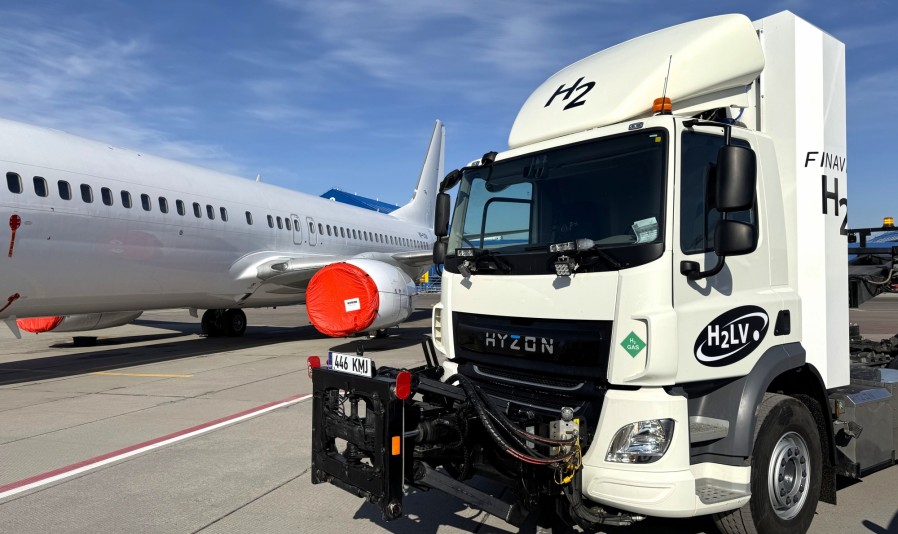
Last week, employees and passengers at Kaunas Airport had the chance to see a remarkable vehicle – a hydrogen-powered Hyzon truck. The heavy-duty vehicle maneuvered across the apron without emitting a single gram of CO₂ and handled its tasks with ease.
Kaunas Airport is participating in a European Union–funded project aimed at promoting the use of more sustainable fuel – hydrogen – across various types of airport equipment, including specialized vehicles. According to Modestas Alekna, Head of Sustainable Aviation Projects at Lithuanian Airports (LTOU), similar testing is taking place at airports in Helsinki, Riga, and Tallinn, highlighting the region’s openness to innovations and technologies associated with major sustainability shifts in the transport sector.
“Ground transport is just as important to airport operations as aircraft. We are active contributors to sustainability-driven change and have embedded green transition goals into our long-term strategy. Green hydrogen is considered a fuel of the future – a clean energy source closely linked to many key renewable energy projects. Testing hydrogen-powered transport, along with the entire Interreg Baltic Sea Region BSR HyAirport project, provides us with valuable experience,” said M. Alekna.

The hydrogen-powered Hyzon truck was brought to Kaunas following a pre-prepared testing plan. Specialists operating the 10-ton vehicle confirmed it could be used on the apron, runway and taxiways to remove snow and dust, as well as perform other surface maintenance tasks. According to M. Alekna, hydrogen-powered transport has never before been tested at Lithuanian Airports. Kaunas Airport was chosen due to lower aircraft traffic and suitable space for such trials.
The initial goal was to cover around 100 kilometres while carrying out standard apron and runway cleaning tasks, so testing lasted several days. Test locations were selected to ensure that, if the Hyzon vehicle stopped operating, it would not disrupt airport activities.
During the trials, the truck operated smoothly and left a positive impression on the specialists. In addition, the mass-produced Toyota Mirai passenger car, also powered entirely by hydrogen, was successfully tested at Kaunas Airport. According to LTOU, only four such vehicles are currently registered in Lithuania. The Toyota Mirai used in the tests was provided by the Latvian Hydrogen Association, which also supplied hydrogen and a refuelling station.
The project partner, the Latvian Hydrogen Association, ensured that only fully green hydrogen was used during the tests at Kaunas Airport, a clean fuel that enables zero CO2 emissions when used in vehicles. “Through electrolysis, water molecules are split into oxygen and hydrogen. When electricity generated from solar and wind energy is used in this process, it does not pollute the environment. In other words, such hydrogen is a versatile energy carrier that helps protect the environment,” said M. Alekna, Head of Sustainable Aviation Projects at LTOU.
LTOU aims to become a CO2-neutral organisation by 2030. In the European Union’s hydrogen strategy for a climate-neutral Europe, hydrogen plays a key role in achieving climate neutrality by 2050.
