Sunshine Coast Airport Begins Installation of Mass Timber Terminal Structure
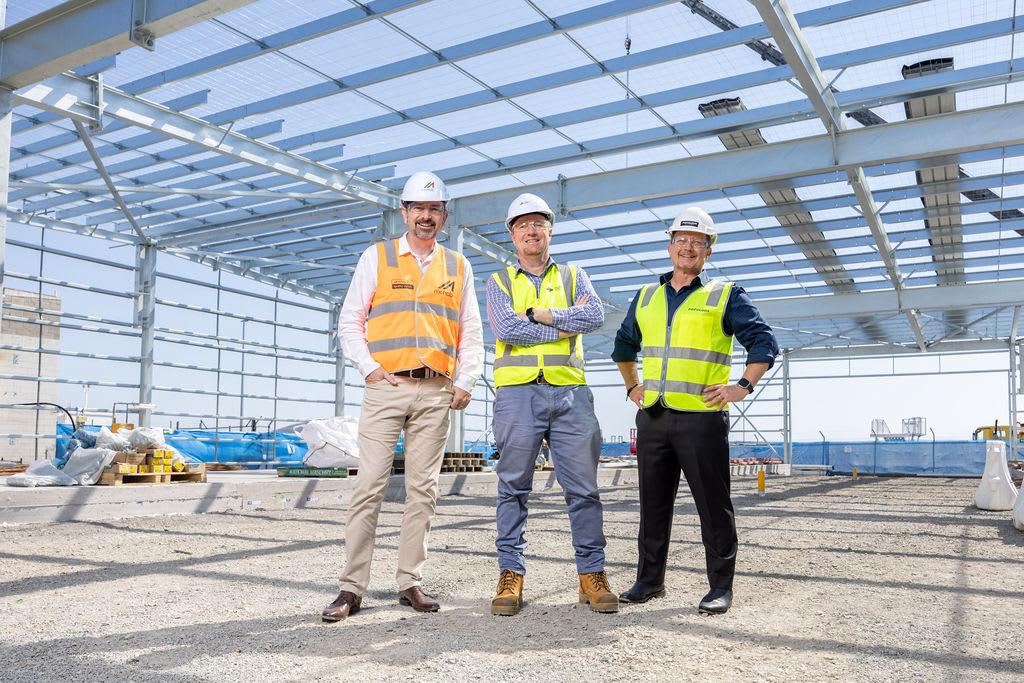
Image credit: Sunshine Coast Airport
Sunshine Coast Airport’s $170 million Terminal Redevelopment Project has reached a new milestone, with installation now underway on around 30 tonnes of timber chosen for its sustainability and environmental benefits, and reflecting the region’s subtropical landscape and laid-back character.
When completed it will be Australia’s first mass timber engineered terminal, creating a passenger environment unlike any other airport in the country. As well as reinforcing the terminal’s connection to the landscape that surrounds it, the use of timber over traditional steel and concrete materials reduces the terminal’s embodied carbon with an estimated Global Warming Potential (GWP) saving of roughly 40 tonnes of CO2 equivalent.
The engineered timber, known as glulam or GLT, is being installed to form the terminal’s dramatic raking roof frames – a defining architectural feature designed by global architecture firm Populous: Fentress Studios’ Australian team in partnership with builder McNab.
Sunshine Coast Airport General Manager Projects and Planning Mr Robin Mace, said seeing the timber structure take shape was a significant moment for the project.
“This is where the vision our community helped shape really starts to come to life.
“The timber frames will become one of the most recognisable features of our new terminal, and watching them go in is an exciting sign of the progress being made on this $170 million investment in our region’s future,” Mr Mace said.
The scale of the installation is unusual for an airport project of this size – at around 30 tonnes, it’s a similar weight to an adult humpback whale, a familiar sight migrating past the Sunshine Coast coastline each year.
“It’s genuinely rare for an airport to use timber at this scale,” said Mr Matt Findlay, Principal & Head of Aviation, APAC at Populous: Fentress Studios.
“Most terminals of this size rely on steel and concrete, so committing around 30 tonnes of glulam to the roof structure is a significant statement about the kind of building we wanted to create – one that feels like nowhere else in Australian aviation,” said Mr Findlay
Airports are widely recognised as high-stress environments – the noise, crowds and navigation involved in getting from drop-off to departure gate can leave even seasoned travellers feeling anxious. The terminal’s design sets out to counter that through biophilic design, a principle that draws on people’s innate connection to the natural world to help lower stress and improve wellbeing. By replacing concrete and steel with warm, exposed timber, the terminal is designed to have a calming effect on passengers from the moment they arrive.
The raking glulam frames have been designed to do more than support the roof – they set the tone for the entire passenger journey.
“For many people, airports reflect the fast pace of modern life,” said Sean Powyer, Associate Principal & Architect at Populous: Fentress Studios.

“The raking timber frames form a distinctive gateway into the terminal, marking the transition from the pressures of everyday life to the relaxed character of the Sunshine Coast. Warm and natural, the exposed structure is designed to create an immediate sense of calm from the moment passengers step off the aircraft.
“The Sunshine Coast is the only place in the world that’s home to three continuous UNESCO Biospheres, and our airport serves as a gateway to three of Australia’s five Biosphere Reserves.
“Timber was a natural choice for the terminal, reflecting the surrounding subtropical rainforest and reinforcing the building’s connection to the landscape it sits within,” Mr Powyer said.
As a renewable material, engineered timber can lower a building’s embodied carbon compared with traditional steel and concrete construction – one of a number of sustainable design principles being explored across the redevelopment.
Installation of the glulam frames will continue over the coming weeks, with specialist timber engineering consultation provided by Theca Timber, as the frames form a key structural and visual feature of the new departures hall, ahead of the terminal’s completion in 2027.
About Sunshine Coast Airport
Sunshine Coast Airport (the Airport) is the gateway to the Sunshine Coast and one of Australia’s fastest growing airports. The Airport directly connects the Sunshine Coast community to domestic and international destinations; Adelaide, Auckland, Singapore via Bali, Cairns, Melbourne and Sydney and is supported by five airlines; Air New Zealand, Alliance, Jetstar, Qantas and Virgin Australia.
Our core markets of Sydney and Melbourne continue to be our most popular route with more than 80 flights per week. Passenger numbers have steadily increased by 10 percent year on year with 1.8 million passengers overall projected in 2026. By 2030, the number of passengers is projected to grow to 2.4 million.
In July 2023, the Airport was declared a Priority Development Area, with a new Development Scheme taking effect in September 2024. As part of the new development scheme, the first development area – the Gateway Precinct – was approved in November 2025. Permitted development includes a hotel, retail expansion, childcare, medical, shopping and other services. The Gateway Precinct is a core part of our strategy to deliver a modern world-class airport that will unlock significant benefits for the region and open-up commercial opportunities for the airport as it grows.
In October 2025, the Airport began its $170 million terminal redevelopment which is set to create a larger terminal with double the footprint to support the future of our airport and the region. The terminal upgrades will include 50 percent more retail food and beverage offerings, departure lounge expanding by three times in size (from 1250sqm to 3750sqm) and a 40 percent increase in airline capacity with two new gates. The first stage of the terminal redevelopment was completed in February 2026, with the opening of the new state-of-the-art outbound baggage facility. The new facility includes major infrastructure upgrades to streamline baggage handling processes from check-in to aircraft.
By 2040, it is estimated the airport will directly contribute $460 million to Australia’s GDP. Jobs created on airport are forecast to grow to 2,400 by 2040 and support a total of 3,438 direct and indirect jobs.
Sunshine Coast Airport Pty Ltd operates and manages Sunshine Coast Airport, the gateway to the Sunshine Coast and Noosa regions, under a 99-year lease from Sunshine Coast Council which commenced in December 2017.
